November 16, 2020 Top game-related math books Mathematics used to be a lot more important for game development than it is now. There are so many tools available for creating all…
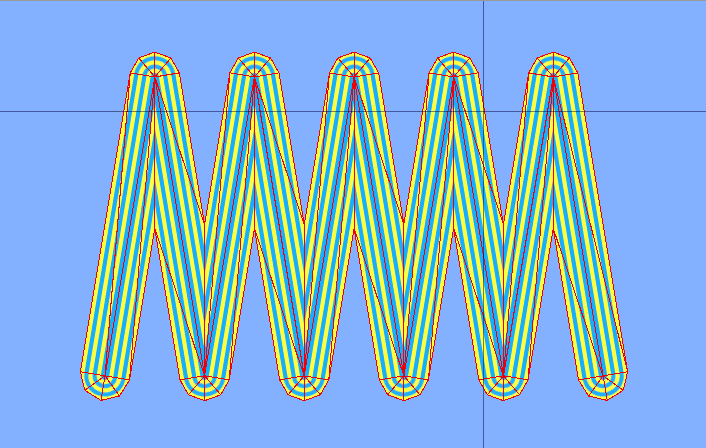
November 10, 2020 Procedural Meshes for Lines in Unity A lines is a fundamental graphics object, but generating attractive, robust lines involve many subtle issues and can be difficult to get right. In…
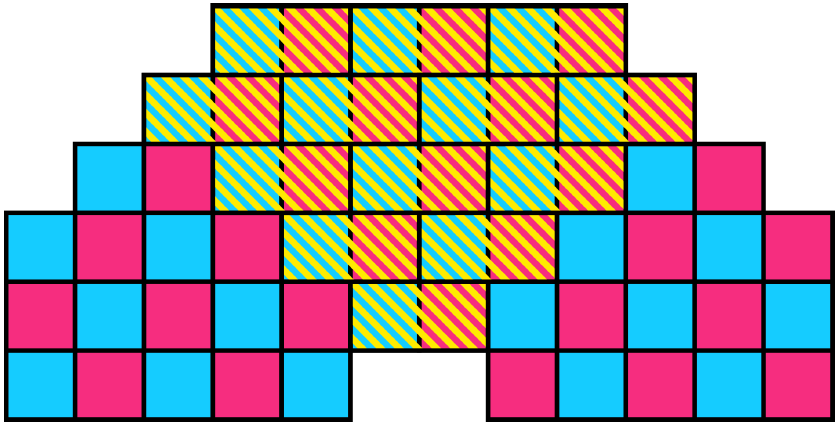
July 22, 2018 Domino Tilings I I started a new project: studying polyomino tilings and related problems (very much inspired by Golomb’s famous Polyominoes). As part of this study, I…
February 20, 2013 Pentagons A while back I developed a mild obsession with pentagons (mathematical ones, not symbolistic!) It started when I discovered some beautiful (simple and to me,…
September 30, 2010 Update to Functional Equations Reference (version 1.3) This is a substantial update of this reference document. The most important addition is the chain and substitution rules for arithmetic difference calculus (ADC)….
May 27, 2009 Update: Reference for Functional Equations In this new version of Reference for Functional Equations I added several more z-transform pairs. I also started to add binomial transform pairs. The definition for…
April 28, 2009 Generating Random Integers With Arbitrary Probabilities I finally laid my hands on Donald Knuth’s The Art of Computer Programming (what a wonderful set of books!), and found a neat algorithm…
April 15, 2009 Estimating a Continuous Distribution from a Sample Set It is sometimes necessary to find the distribution given a sample set from that distribution. If we do not know anything about the distribution,…
April 15, 2009 Generating Random Points from Arbitrary Distributions for 2D and Up I have already covered how to generate random numbers from arbitrary distributions in the one-dimensional case. Here we look at a generalisation of that…
February 26, 2009 A Reference for Functional Equations I have not posted in a while; one reason is that I got sucked into some interesting mathematics; the work-in-progress Reference for Functional Equations is…