Algorithms

You are currently browsing the archive for the Algorithms category.

(Original Image by Valerie Everett)

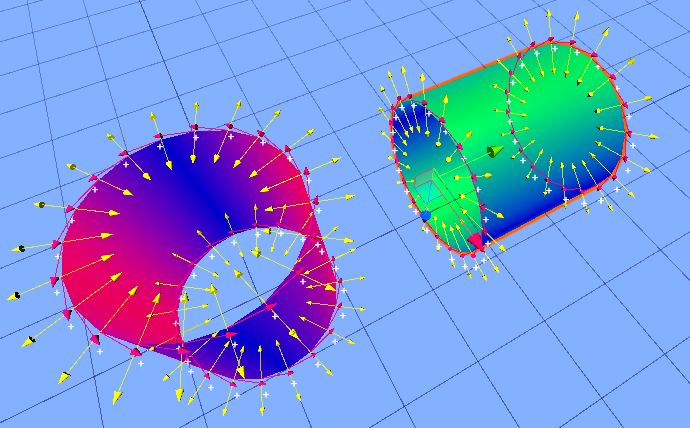
It is sometime necessary to move an object in a physics simulation to a specific point. On the one hand, it can be difficult to analyse the exact force you have to apply; on the other hand it might not look so good if you animate the object’s position directly.

A compromise that works well in many situations is to use a spring-damper system to move the object.

The trick is simple: we apply two forces—the one is proportional to the displacement; the other is proportional to the velocity. Tweaked correctly, they combine to give realistic movement to the desired point.

Read the rest of this entry »

  • Share/Bookmark

Tags: , , , , , , ,

quadtree

(Original image by GoAwayStupidAI).

Below are four C++ implementations of the region quadtree (the kind used for image compression, for example). The different implementations were made in an attempt to optimise construction of quadtrees. (For a tutorial on implementing region quadtrees, see Issue 26 [6.39 MB zip] of Dev.Mag).

  • NaiveQuadtree is the straightforward implementation.
  • AreaSumTableQuadtree uses a summed area table to perform fast calculations of the mean and variance of regions in the data grid.
  • AugmentedAreaSumTableQuadtree is the same, except that the area sum table has an extra row and column of zeros to prevents if-then logic that slows it down and makes it tricky to understand.
  • SimpleQuadtree is the same as AugmentedAreaSumTableQuadtree , except that no distinction is made (at a class level) between different node types.

Read the rest of this entry »

  • Share/Bookmark

Tags: , , , ,

crash test dummy

When implementing image algorithms, I am prone to make these mistakes:

  • swapping x and y;
  • working on the wrong channel;
  • making off-by-one errors, especially in window algorithms;
  • making division-by-zero errors;
  • handling borders incorrectly; and
  • handling non-power-of-two sized images incorrectly.

Since these types of errors are prevalent in many image-processing algorithms, it would be useful to develop, once and for all, general tests that will catch these errors quickly for any algorithm.

This post is about such tests.

Read the rest of this entry »

  • Share/Bookmark

Tags: , , , , ,

minmax

*Fast = not toooo slow…

For the image restoration tool I had to implement min and max filters (also erosion and dilation—in this case with a square structuring element). Implementing these efficiently is not so easy. The naive approach is to simply check all the pixels in the window, and select the maximum or minimum value. This algorithm’s run time is quadratic in the window width, which can be a bit slow for the bigger windows that I am interested in. There are some very efficient algorithms available, but they are quite complicated to implement properly (some require esoteric data structures, for example monotonic wedges (PDF)), and many are not suitable for floating point images.

So I came up with this approximation scheme. It uses some expensive floating point operations, but its run time is constant in the window width.

Read the rest of this entry »

  • Share/Bookmark

Tags: , , , , , , ,

poissonI decided to put the Poisson disk sampling code here for download since the site that hosted it is down. The code accompanies the tutorial on Dev.Mag: Poisson Disk Sampling.

Download

poisson_disk_java.zip (184 KB)
poisson_disk_python.zip (912 KB)
poisson_disk_ruby.zip (59 KB)
  • Share/Bookmark

7 April 2010 | No comments

neuron

(Original image by Hljod.HuskonaCC BY-SA 2.0).

I used to hate neural nets. Mostly, I realise now, because I struggled to implement them correctly. Texts explaining the working of neural nets focus heavily on the mathematical mechanics, and this is good for theoretical understanding and correct usage. However, this approach is terrible for the poor implementer, neglecting many of the details that concern him or her.

This tutorial is an implementation guide. It is not an explanation of how or why neural nets work, or when they should or should not be used. This tutorial will tell you step by step how to implement a very basic neural network. It comes with a simple example problem, and I include several results that you can compare with those that you find.

Read the rest of this entry »

  • Share/Bookmark

Tags: , , , , , , , ,

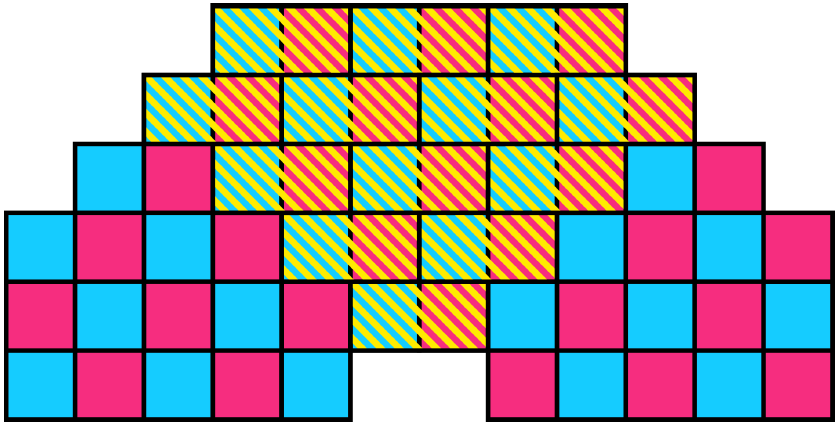
tiles_header_smallI wrote an article for Dev.Mag covering some techniques for working with seamless tile sets such as making blend tiles, getting more variety with procedural colour  manipulation, tile placement strategies, and so on. 

Check it out!

The Python Image Code has also been updated with some of the algorithms explained in the article.

  • Share/Bookmark

28 May 2009 | No comments

header

I finally laid my hands on Donald Knuth’s The Art of Computer Programming (what a wonderful set of books!), and found a neat algorithm for generating random integers 0, 1, 2, … , n – 1, with probabilities p_0, p_1, … , p_(n-1).

I have written about generating random numbers (floats) with arbitrary distributions for one dimension and higher dimensions, and indeed that method can be adapted for generating integers with specific probabilities. However, the method described below is much more concise, and efficient (I would guess) for this special case. Moreover, it is also easy to adapt it to generate floats for continuous distributions.

Read the rest of this entry »

  • Share/Bookmark

Tags: , , , , , , ,

header_rand_dist2 It is sometimes necessary to find the distribution given a sample set from that distribution. If we do not know anything about the distribution, we cannot recover it exactly, so here we look at ways of finding a (discrete) approximation.

Read the rest of this entry »

  • Share/Bookmark

Tags: , , , , ,

header_rand_dist

I have already covered how to generate random numbers from arbitrary distributions in the one-dimensional case. Here we look at a generalisation of that method that works for higher dimensions.

The basic trick, while easy to understand, is hard to put in words (without reverting to mathematical equations). For two dimensions, we divide the plane into slices. Each slice is a 1D distribution. We also calculate a distribution from summing the frequencies in each slice. The latter distribution gives us one coordinate, and the appropriate slice to use. The distribution of that slice then gives the second coordinate. All distributions are put into inverse accumulative response curves as was done to generate one-dimensional random numbers. (You should review that before implementing the 2D case).

In more dimensions, we also slice the space up into 1D distributions. Sums of these give us more distributions, which we can sum again, and again, until we reach a single distribution. This is used for the first coordinate, and to determine which distribution to use for the next coordinate. This goes on, until a 1D slice gives us the final coordinate. Again, all distributions are converted to inverse accumulative response curves.

If the above is unclear, I hope the detailed description below clears things up.

Read the rest of this entry »

  • Share/Bookmark

Tags: , , , , , , , , ,

« Older entries